
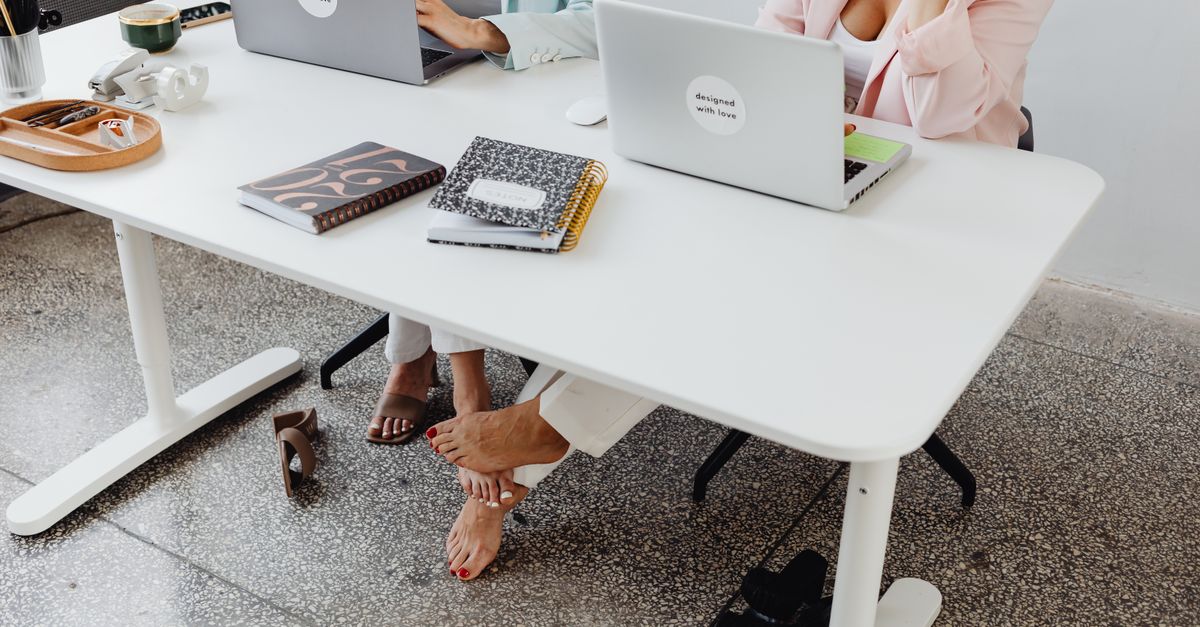
Desk worker leg circulation refers to the challenge of maintaining healthy blood flow in the lower limbs during prolonged seated work. When you sit for extended periods, the calf muscles — which act as a secondary pump for venous return — become inactive, allowing blood to pool in the legs and feet. Improving leg circulation as a desk worker requires a combination of posture adjustments, scheduled movement breaks, targeted desk exercises like ankle pumps and calf raises, and tools such as an under-desk foot massager that introduce continuous lower-limb movement without interrupting work.
You're two hours into your workday, the emails haven't stopped, and the last thing on your mind is your legs. But somewhere around hour three, that familiar heaviness starts — a dull ache in the calves, swollen ankles by afternoon, feet that feel stiff the moment you finally stand up. These aren't random complaints. They're the predictable result of what prolonged sitting does to desk worker leg circulation. This guide is written specifically for office and remote workers who spend most of their day seated — not for drivers, not for people with back pain, but for anyone whose lower limbs pay the price for a screen-heavy workday. We'll cover the physiology behind why sitting stalls blood flow in your legs, what you can do about it right now, and how to build a sustainable daily routine that keeps circulation moving from 9 to 5.
Why Sitting Slows Leg Circulation
The problem isn't just that you're sitting — it's what sitting does to the system your body relies on to move blood back up from your legs. Understanding that system makes the solutions obvious.
The Calf Muscle Pump
Your heart pushes oxygenated blood down to your legs with relative ease — gravity helps. Getting that blood back up is a different story. The venous system in your lower limbs depends heavily on what physiologists call the calf muscle pump: the rhythmic contraction of the gastrocnemius and soleus muscles that squeeze the deep veins of the leg, pushing blood upward against gravity through a series of one-way valves.
When you walk, climb stairs, or even shift your weight while standing, this pump fires continuously. When you sit still for hours, it essentially stops. Blood that should be circulating back to the heart instead pools in the superficial veins of the calves, ankles, and feet — producing the swelling, heaviness, and stiffness that desk workers know well by mid-afternoon.
How Seat Position Makes It Worse
The way most office workers actually sit compounds the problem. A seat that is too high leaves the feet dangling, compressing the underside of the thigh against the chair edge and partially occluding the femoral vein — one of the major vessels returning blood from the leg to the heart. A seat that is too low forces the knees above hip level, increasing pressure in the popliteal area behind the knee.
Slouching forward matters more than most people realize. When the pelvis tilts backward in a slumped posture, the hip flexors shorten and pressure on the inguinal region increases, partially restricting blood flow at the top of the leg. None of these positions cause dramatic harm in a single sitting. Repeated across eight or more hours a day, five days a week, the cumulative effect on lower-limb circulation is significant.
What Prolonged Sitting Does Over Time
Research published in journals including the American Journal of Physiology has examined how quickly vascular function in the legs begins to degrade during uninterrupted sitting. Studies have found measurable reductions in arterial function after as little as one hour of seated inactivity, with flow-mediated dilation declining notably in that window. Over years, chronically poor leg circulation is associated with a higher risk of varicose veins, deep vein thrombosis (DVT), and chronic venous insufficiency.
This is distinct from back pain caused by prolonged sitting — a related but separate problem driven by spinal loading and lumbar muscle fatigue. The leg circulation issue is vascular and muscular at its root: the problem is inactivity of the calf pump, not posture alone.
Desk Posture That Supports Leg Circulation
Before adding movement breaks or desk exercises to your routine, the chair itself needs to be set up correctly. Good posture is the baseline — not the complete solution, but a necessary starting point.
Chair Height and Foot Position
The single most important adjustment for leg circulation is chair height. Your feet should rest flat on the floor — or on a footrest — with your knees at approximately a 90-degree angle and your thighs roughly parallel to the floor. This minimizes compression on the underside of the thigh and keeps the femoral and popliteal veins as unobstructed as possible during seated work.
- Feet flat on the floor or on a firm footrest — never dangling
- Knees at or slightly below hip level
- Two to three fingers of clearance between the back of the knee and the seat edge
- Thighs not pressed hard against the seat pan — excessive seat depth compresses the thigh
If your desk is fixed-height and your chair can't be lowered enough to achieve flat foot contact, a footrest isn't optional — it's essential. Even a firm foam wedge or a stack of books works in a pinch.
Lumbar Support and Pelvic Position
Maintaining a neutral lumbar curve keeps the pelvis in a position that reduces pressure on the inguinal region at the top of the leg. Sit with your back against the chair back, lumbar support positioned to fill the natural inward curve of your lower back. Avoid the forward-perched position many desk workers default to — it collapses the lumbar curve, tips the pelvis backward, and increases groin-area compression.
Active sitting tools like balance discs or ergonomic stools introduce micro-movements into the pelvis and core throughout the day, which provides modest benefits for leg circulation by preventing complete muscular stasis.
How Movement Breaks Restore Venous Return
Posture optimization reduces the damage — movement breaks actually reverse it. Regular interruptions to sitting are among the most well-supported strategies for maintaining desk worker leg circulation throughout the workday.
The Case for Hourly Breaks
Research on sitting interruptions consistently points to frequency over duration. Breaking up sitting every 30 to 60 minutes — even briefly — produces measurable benefits for vascular function and blood glucose regulation compared to uninterrupted sitting, even when total daily sitting time is identical. A two-minute walk to refill a water glass, a trip to a colleague's desk, or a standing stretch all activate the calf pump and restore arterial function in the legs.
A practical approach: set a recurring timer for 50 minutes. When it fires, stand, walk briefly, and return. This one change costs less than two hours of total standing time across an eight-hour day and meaningfully interrupts the vascular stagnation that accumulates during long desk sessions.
What Counts as a Movement Break
Not all breaks are equal for leg circulation. The goal is calf muscle activation — any activity that contracts the gastrocnemius and soleus counts:
- Walking, even just to another room
- Standing and performing 10 calf raises
- Taking stairs instead of elevators during the break
- A brief walk outside during lunch (5–10 minutes of continuous walking provides substantial circulatory benefit)
Standing alone, without movement, provides less benefit than it might seem. The calf pump requires muscle contraction — standing still keeps the pump mostly dormant. Prioritize steps over stationary standing when choosing how to use your break.
Desk Exercises for Better Leg Circulation
Movement breaks help, but you can't leave your desk every hour in every meeting. Seated desk exercises fill the gap — they activate the calf pump without requiring you to stand, and most can be performed silently during calls or while reading.
Ankle Pumps
Ankle pumps are the most direct way to activate venous return from a seated position. They mimic the muscular action of walking by alternately contracting the calf and shin muscles, squeezing the deep veins of the lower leg.
- Sit with feet flat on the floor, knees at 90 degrees
- Lift your toes toward your shins (dorsiflexion), hold briefly
- Point your toes toward the floor (plantarflexion), hold briefly
- Repeat 15–20 times per set, 2–3 sets per hour as needed
Hospital rehabilitation programs use ankle pumps as a standard DVT prevention technique following surgery precisely because they effectively drive venous return when walking is impossible. At a desk, they're a practical substitute for the steps you're not taking.
Seated Calf Raises
Seated calf raises add resistance to the ankle pump motion by loading the calf muscles against bodyweight. Sit with feet flat, then drive the heels upward off the floor until you're on the balls of your feet. Hold for one to two seconds at the top, then lower slowly. Ten to fifteen repetitions create a meaningful calf contraction that significantly increases venous return for several minutes after.
You can progress this exercise by placing a heavy book or laptop bag across your thighs for added resistance — this increases the muscular workload and extends the circulatory benefit.
Foot Circles and Toe Spreads
Ankle circles — rotating the foot in full circles, 10 in each direction — mobilize the ankle joint and activate the smaller muscles of the foot and lower calf. Toe spreads, where you actively spread the toes apart and hold, engage the intrinsic foot muscles and stimulate superficial blood vessels in the foot. These are lower-intensity than ankle pumps but useful as a lighter option during very focused work when more vigorous movement would be distracting.
Using an Under-Desk Foot Massager for Circulation
Desk exercises work well — but they require your active attention and effort. An under-desk therapeutic foot massager offers something different: continuous lower-limb stimulation while you work, without requiring you to stop and perform a set of ankle pumps. For desk workers managing circulation through a long seated day, this is a meaningful addition to the toolkit.
How Oscillating Foot Massagers Support Circulation
Many desk workers search for a vibrating foot massager to use while working — and that instinct is correct, because vibration-based stimulation does activate muscle tissue in the foot and lower leg. MedMassager's therapeutic foot massagers use oscillating technology rather than simple vibration, delivering deeper, more controlled movement through the foot that better activates the calf muscle pump. Repeated foot motion drives blood upward through the lower leg instead of letting it pool in the feet — the same basic mechanism as walking, produced passively while you remain seated.
For desk workers, this means the calf pump can remain at least partially active during meetings, focused work blocks, or any time standing up and walking isn't practical. It doesn't replace movement breaks — but it meaningfully reduces the cost of the long periods between them.
A Structured Daily Routine
Getting the most out of an under-desk foot massager for circulation requires using it intentionally, not just running it passively in the background. This routine works well for a standard eight-hour desk workday:
- Morning session (first 30 minutes of work): Start at low to medium intensity while you clear email and ease into the day. This primes circulation before it has a chance to stagnate.
- Mid-morning block (before your first movement break): Run the massager for 15–20 minutes during your longest uninterrupted work block — typically the hardest stretch to manage with manual exercises.
- Post-lunch session: After returning from a lunch break, run a 10–15 minute session at medium intensity. Post-meal circulation can lag as blood is directed toward digestion — a foot massager session helps maintain lower-limb flow during this window.
- Afternoon block: Use a 15–20 minute session during your most focused afternoon work period, when the option to get up and walk is lowest but the need for circulation support is highest.
Total daily usage: 60–90 minutes, distributed across the day in shorter sessions rather than one long block. MedMassager's professional-grade therapeutic massagers are built for extended use, with variable speed settings that let you adjust intensity based on how your legs feel at different points in the day.
Positioning and Settings for Desk Use
Place the massager flat under your desk with enough clearance so your feet rest naturally on the surface without your legs being raised above knee level. Begin at lower speeds and increase only if comfortable. Remove shoes for best contact, though thick socks are fine if office temperature or comfort requires them.
People managing conditions like neuropathy or diabetes should consult their healthcare provider before starting a foot massager routine — reduced sensation in the feet makes it important to verify comfortable intensity levels before extended use. These tools are built for people managing circulation challenges, but individual medical guidance always takes priority.
Building a Complete Daily Circulation Routine
The most effective approach combines all of the above into a structured daily routine rather than relying on any single strategy. Here's how to stack the elements across a workday:
Morning Setup
Before you sit down, confirm your chair height — feet flat, knees at 90 degrees, two to three fingers of clearance behind the knee. Set your hourly break timer. Place your foot massager under your desk and start a low-intensity session as you begin work.
Hourly Rhythm
Every 50–60 minutes, stand and walk briefly — even a short lap around the room counts. On the return, do one set of 15 ankle pumps and 10 seated calf raises before settling back in. Run the foot massager during your next focused block. This cycle — movement break, desk exercise set, massager session — is the core of the routine.
End-of-Day Wind-Down
Before closing your laptop, spend five minutes with a final foot massager session at medium intensity. After long sitting days, elevating your legs for 10–15 minutes post-work — lying down with legs propped above heart level — allows gravity to assist venous drainage and reduces end-of-day swelling. Hydration matters here too: well-hydrated blood is less viscous and circulates more efficiently.
Frequently Asked Questions
Why do my legs swell after sitting at a desk all day?
Leg swelling after prolonged sitting occurs because the calf muscle pump — the muscular system responsible for pushing blood back up from the legs to the heart — becomes inactive when you're seated and still. Without regular calf muscle contraction, blood and fluid pool in the lower legs, ankles, and feet, causing the swelling and heaviness many desk workers notice by afternoon. Standing up and walking briefly restores calf pump activity and typically reduces swelling within 10–15 minutes of movement.
How often should I get up from my desk to improve leg circulation?
Research on sitting interruptions generally supports getting up every 30 to 60 minutes as a practical target for maintaining leg circulation during desk work. Even brief movement — two to three minutes of walking — is sufficient to reactivate the calf muscle pump and partially reverse the vascular changes that accumulate during uninterrupted sitting. Frequency matters more than the duration of each break.
What are the best exercises to do at a desk for leg circulation?
Ankle pumps and seated calf raises are the most effective desk exercises for leg circulation because they directly activate the calf muscle pump that drives venous return. Both can be performed silently during meetings or focused work without standing up. Ankle circles and toe spreads offer lighter supplemental movement between sets.
Can poor leg circulation from sitting cause blood clots?
Prolonged uninterrupted sitting is a recognized risk factor for deep vein thrombosis (DVT), a type of blood clot that forms in the deep veins of the leg. The risk is higher during very long periods of immobility — such as long-haul flights or extended hospitalization — than during a typical office workday with normal movement patterns. If you experience sudden calf pain, significant swelling, warmth, or redness in one leg, seek medical attention promptly rather than assuming it is fatigue or muscle soreness.
Does chair height affect leg circulation at a desk?
Yes, chair height directly affects leg circulation. A seat that is too high causes the thighs to press against the seat edge, compressing the femoral vein and partially restricting blood returning from the leg. A seat set at the correct height — feet flat on the floor, knees at approximately 90 degrees — minimizes vascular compression in the thigh and behind the knee, supporting better circulation during seated work.
Does a foot massager help with leg circulation for desk workers?
A therapeutic foot massager can support leg circulation during prolonged desk work by introducing mechanical movement in the foot that activates the calf muscle pump — the same muscular action that occurs when walking. Oscillating foot massagers produce repeated foot motion that drives blood upward through the lower leg, partially compensating for the calf pump inactivity caused by sustained sitting. They work best as part of a broader routine that also includes movement breaks and desk exercises.
How is desk worker leg circulation different from circulation problems in drivers?
Both involve prolonged sitting, but the mechanisms and contributing factors differ. Desk workers typically have more flexibility to interrupt sitting with movement breaks and perform desk exercises freely — the primary challenge is building habits that counteract calf pump inactivity. Drivers face additional constraints: the foot is actively engaged with pedals, movement breaks require stopping the vehicle, and cab seat designs often create more thigh compression than office chairs. The interventions appropriate for each context are meaningfully different as a result.
The Bottom Line for Desk Workers
Desk worker leg circulation isn't a minor inconvenience — it's a real physiological consequence of how modern knowledge work is structured, and it compounds over months and years of sedentary seated days. The good news is that the interventions are practical, low-cost, and highly effective when applied consistently.
Start with your chair: feet flat, knees at 90 degrees, seat edge clear of the back of the knee. Add an hourly timer and treat those breaks as non-negotiable. Layer in ankle pumps and seated calf raises during your longest work blocks. And for the sessions where leaving your desk simply isn't possible, an under-desk therapeutic foot massager keeps your calf pump active without requiring you to stop working.
MedMassager's professional-grade Foot Massagers are FDA-registered Class I medical devices built specifically for the kind of sustained, therapeutic use that a desk workday demands. If your legs are telling you something has to change, this is where to start.
This content is for informational purposes only and is not intended as medical advice, diagnosis, or treatment. Always consult a qualified healthcare professional before starting any new treatment or therapy. MedMassager products are FDA-registered Class I medical devices.


