
A morning leg routine for circulation starts before your feet touch the floor — ankle pumps, calf raises, and gentle range-of-motion movements performed in bed help restart blood flow after hours of stillness. Adults over 50 often wake with stiff, heavy, or swollen legs because blood naturally pools in the lower extremities during sleep. Following these bed-based exercises with a 10-minute therapeutic foot massager session helps activate calf muscles and push blood upward through the legs. Done consistently each morning, this sequence can reduce that groggy, lead-weight feeling in your feet and lower legs within the first few minutes of your day.
That first step out of bed tells you a lot. For many adults over 50, it comes with a familiar sensation — feet that feel stiff, heavy, or oddly disconnected from the rest of the body. Ankles that need a moment before they want to cooperate. A morning leg routine for circulation addresses exactly this window: the transition from hours of stillness to upright movement, when your lower legs need a little help getting blood moving again.
This isn't about an intense workout before breakfast. It's about a deliberate, low-effort sequence that wakes up the circulatory system in your legs the same way a cup of coffee wakes up your brain. The sections below cover why legs feel the way they do after sleep, which movements help most before you even stand up, how a foot massager fits into a morning routine, and how to build this into a habit that actually sticks.
Why Legs Feel Heavy and Stiff Every Morning
The heavy, slow feeling in your legs first thing in the morning isn't random — it's a predictable consequence of how circulation behaves during sleep. Understanding what's actually happening makes the routine feel less like a chore and more like a logical fix.
Blood Pooling During Sleep
When you lie down for seven or eight hours, your calf muscles stop pumping. That matters more than most people realize. The calf muscle acts as a secondary heart for your lower body — its contractions during walking and standing push blood back up through the veins toward the heart. When you're horizontal and still, that pump goes largely dormant.
As a result, blood and fluid tend to collect in the lower legs and feet overnight. For adults over 50, this process is more pronounced because vein wall elasticity and valve function naturally decline with age, according to research in venous physiology. The legs that felt fine at 10 p.m. can wake up feeling thick and reluctant at 6 a.m.
The Role of Age and Reduced Circulation
Peripheral circulation — blood flow to the hands and feet — tends to slow gradually as we age. Arterial walls become less flexible, and the microvascular network in the feet and lower legs can become less responsive to demand. This doesn't mean poor circulation is inevitable, but it does mean that the recovery period after prolonged stillness gets longer.
People managing conditions like diabetes, chronic venous insufficiency, or peripheral arterial disease often notice this most acutely in the morning. Even adults without diagnosed conditions frequently report that their feet need 10 to 20 minutes before they feel fully functional. That window is exactly where a structured morning leg routine does its most useful work.
Why Morning Is the Right Time to Intervene
The transition from lying to standing is a genuine circulatory challenge. Blood pressure shifts, fluid redistributes, and the lower extremities have to rapidly adapt. For some people, this happens so fast they never notice it. For others — particularly those with circulation concerns, varicose veins, or leg heaviness — that transition can feel rough for 20 minutes or more.
Activating the legs before standing, rather than after, changes this dynamic. Gentle pre-standing movement primes the calf pump, moves pooled fluid upward, and gives the vascular system a head start before gravity kicks in fully. It's a small shift in sequence that produces a noticeable difference in how the first hour of the day feels.
The Morning Leg Activation Sequence
This sequence is designed to be performed lying in bed or sitting on the edge of the mattress. It takes roughly five minutes, requires no equipment, and targets the specific muscle groups responsible for driving venous return from the lower legs.
Step 1 — Ankle Pumps (2 Minutes)
Start with your legs extended flat on the bed. Flex your feet upward toward your shins as far as comfortable — this is dorsiflexion. Then point them away from you, extending through the toes — plantarflexion. Move slowly and deliberately, not quickly. Each full cycle should take about three seconds.
Ankle pumps are the most studied bedside exercise for lower-leg venous return. They directly activate the soleus and gastrocnemius muscles — the primary drivers of the calf pump — without requiring you to stand or bear weight. Aim for 20 to 30 repetitions per foot. If one ankle feels stiffer, spend a few extra cycles on that side.
Step 2 — Ankle Circles (1 Minute)
Keep your legs extended. Slowly rotate each ankle in a full circle — clockwise for five rotations, then counterclockwise for five. This adds range-of-motion work to the ankle joint itself, which stiffens during sleep from reduced synovial fluid circulation. Circles also engage the peroneal muscles along the outer lower leg, which ankle pumps alone don't reach.
Move through the full range of motion without forcing it. If your ankles crack or pop on the first few circles, that's normal — it tends to resolve within the first minute of movement.
Step 3 — Knee-to-Chest Pulls (1 Minute)
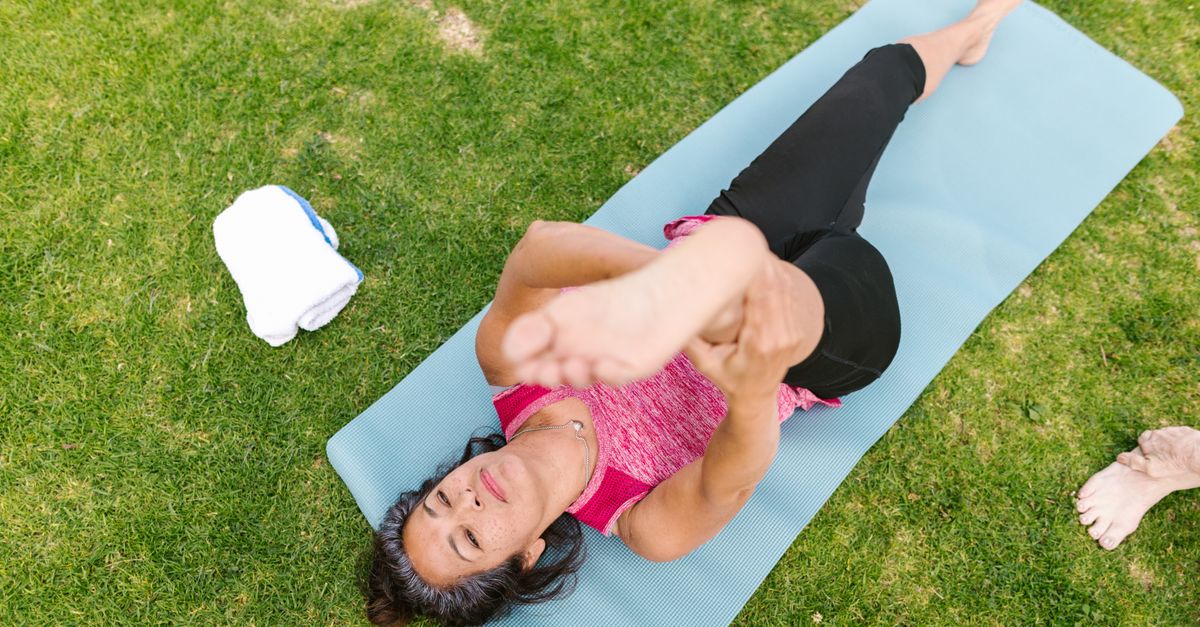
Still lying flat, bend one knee and gently pull it toward your chest using both hands. Hold for five seconds, then release and switch sides. This gentle hip flexion movement engages the larger muscle groups of the upper leg and hip, and the pulling action slightly compresses the femoral vein region, which helps push blood upward toward the core.
This movement also doubles as a lower back stretch — a secondary benefit for the many adults over 50 who wake with lumbar stiffness alongside leg heaviness.
Step 4 — Seated Calf Raises (1 Minute)
Sit on the edge of the bed with both feet flat on the floor. Raise your heels as high as comfortable, then lower them slowly. This is the closest approximation to standing calf raises you can do while still partially supported — and it's the transition movement between the bed-based sequence and standing upright.
- 10–15 repetitions, slow and controlled
- Pause briefly at the top of each raise
- Keep both feet parallel, hip-width apart
- If balance is a concern, hold the mattress edge lightly
After a set of seated calf raises, most people notice their legs feel noticeably different from when they first woke up — less leaden, more responsive. This is a good time to take your first standing steps of the day.
How a Foot Massager Supports Morning Circulation
The exercises above restart the calf pump through active muscle contractions. A therapeutic foot massager extends that work through a different mechanism — sustained oscillating movement that keeps blood flowing without requiring any additional effort from you.
What Oscillation Does That Stretching Alone Doesn't
Oscillating foot massagers work by producing continuous rhythmic motion through the foot, which activates the muscles of the calf and lower leg repeatedly over a sustained period. This is different from a stretch, which engages a muscle and releases it — oscillation keeps the pump cycling throughout the session.
For adults managing circulation concerns, that extended activation window matters. A five-minute stretch routine does useful work. A five-minute stretch routine followed by a 10-minute therapeutic foot massager session continues that work through a different mechanism, compounding the effect over a longer window.
Where the Foot Massager Fits in the Morning Sequence
The ideal placement is immediately after the bed-based sequence and before the demands of your morning begin — before breakfast, before showering, before screens. Sit in a chair or on the couch, place both feet on the MedMassager Foot Massager, and run a 10-minute session at a comfortable intensity while your coffee brews.
This placement is intentional. Your legs have already been primed by the ankle pumps and calf raises, so the massager is continuing circulation work that's already in progress rather than starting from a dead stop. The oscillating platform maintains calf muscle activation across both legs simultaneously, and you can adjust the speed to match how your feet feel that particular morning.
Vibration, Oscillation, and Why the Difference Matters
Many people search for a vibrating foot massager when looking for circulation support — and that's the right category. MedMassager uses oscillating technology to deliver deeper, more controlled vibration than conventional massagers. Where a standard vibrating platform produces rapid surface-level buzzing, oscillation produces a wider arc of motion that engages the full calf muscle group more effectively.
This distinction matters most for people with significant morning heaviness or diagnosed circulation concerns. The deeper muscle engagement from oscillation produces more meaningful calf pump activation than surface vibration alone, which is why MedMassager's Foot Massager has been used in clinical and physical therapy settings for over 15 years. You can explore the full range of MedMassager therapeutic massagers to find the right fit for your morning routine.
Building This Into a Habit That Lasts
The routine itself is straightforward. The harder part is making it automatic. Adults over 50 who establish morning circulation habits report better compliance when the routine is attached to an existing behavior rather than treated as a separate task.
Habit Stacking for Consistency
Habit researchers use the term "habit stacking" — anchoring a new behavior to one that already exists automatically. For a morning leg routine, the most natural stack points are:
- Before getting out of bed: begin ankle pumps as soon as you wake up, while still lying flat
- While waiting for coffee or tea: run the foot massager session during this natural pause
- Before putting on shoes: complete seated calf raises as a transition into getting ready
The goal is to eliminate decision-making from the equation. When ankle pumps happen automatically as part of waking up — the same way reaching for your phone might — the routine maintains itself without relying on willpower.
Managing Expectations: What to Feel and When
Most people notice a difference in morning leg heaviness within the first week of consistent practice. The sensation is typically described as the legs "waking up" faster — less of the 20-minute lag before feet feel normal. This isn't a dramatic transformation; it's a reduction in the transition time between sleep and full function.
People managing chronic venous insufficiency, diabetes-related circulation concerns, or restless legs often report more gradual improvement over two to four weeks of consistent use. The routine works by accumulation — each morning session builds slightly on the last.
When to Adjust Intensity
Some mornings, legs feel more swollen or heavy than usual. On those mornings, extend the ankle pump phase to three minutes rather than two, and run the foot massager at a slightly lower intensity for a longer session — 15 minutes instead of 10. On mornings where legs feel relatively normal, the standard five-minute bed sequence followed by a 10-minute massager session is sufficient.
The routine should never cause pain. Mild muscle activation or a pulling sensation during calf raises is expected. Sharp pain, cramping that doesn't resolve, or significantly asymmetric swelling in one leg warrants a conversation with your doctor before continuing.
Special Considerations for Specific Conditions
The general routine above is appropriate for most adults with circulation concerns. Certain conditions, though, call for specific adjustments.
Diabetes and Peripheral Neuropathy
Adults managing diabetes often have reduced sensation in the feet, which affects how they perceive massage intensity. When using a foot massager for diabetes-related circulation support, start at the lowest speed setting and assess comfort before increasing. The oscillating motion activates the calf muscles and helps push blood upward — particularly valuable when natural walking is limited or painful.
Check the feet visually after each session, especially if neuropathy reduces sensation. The massager should leave no marks, redness, or irritation. Always clear therapeutic massager use with your endocrinologist or podiatrist if you have active diabetic foot complications.
Chronic Venous Insufficiency
For adults with diagnosed chronic venous insufficiency, the order of the morning routine matters. Perform the bed-based exercises before standing to minimize the impact of gravity on already-stressed venous valves. If your doctor has prescribed compression stockings, put them on after the foot massager session — not before — so the massager can work directly against the skin and deliver its full oscillating effect.
Restless Legs Syndrome
Adults managing RLS often find that morning activation reduces daytime symptom frequency. Continuous oscillation introduces low-level movement in the legs, helping prevent prolonged stillness — the primary trigger for RLS discomfort. A morning foot massager session can be a useful complement to whatever evening management routine your neurologist has recommended.
Frequently Asked Questions
How long should a morning leg routine for circulation take?
A complete morning leg routine for circulation takes approximately 15 minutes: roughly five minutes of bed-based exercises (ankle pumps, circles, knee pulls, and seated calf raises) followed by a 10-minute foot massager session. Most people find this length sustainable long-term, which matters more than a more intensive routine that gets abandoned after two weeks.
Why do my legs feel heavy and stiff every morning?
Morning leg heaviness is caused primarily by blood and fluid pooling in the lower extremities during sleep, when the calf muscle pump is inactive. This effect becomes more pronounced with age as vein wall elasticity and valve function gradually decline. Adults over 50 commonly experience a longer recovery window after lying down, which is why deliberate morning movement that reactivates the calf pump makes a noticeable difference in how quickly the legs feel functional again.
Can ankle pumps really improve leg circulation?
Yes — ankle pumps are one of the most well-supported bedside interventions for lower-leg venous return. They directly engage the soleus and gastrocnemius muscles, which function as the primary venous pump for the lower leg. Even modest repetitions of 20 to 30 per foot produce meaningful increases in blood flow velocity in the deep veins of the calf. Ankle pumps are routinely recommended by physical therapists and hospital protocols for patients who have been immobile for extended periods.
Is it safe to use a foot massager every morning?
For most adults, daily morning use of a therapeutic foot massager is safe and well-tolerated. A 10-minute session at a comfortable intensity falls within typical recommended use guidelines. If you have active foot wounds, severe peripheral arterial disease, deep vein thrombosis, or diabetic foot complications, consult your doctor before beginning regular foot massager use. Daily use generally produces greater cumulative benefit than occasional sessions.
What is the best time of day to use a foot massager for circulation?
Morning and evening foot massager sessions serve distinct purposes. Morning sessions help restart circulation after overnight stillness, reducing the heavy, slow feeling many adults experience in the first hour after waking. Evening sessions help clear fluid and reduce swelling that has accumulated through the day. If you can only commit to one session daily, morning use is often more impactful for people whose primary complaint is morning stiffness and heaviness rather than end-of-day swelling.
How many reps of ankle pumps should I do in the morning?
A practical starting point is 20 to 30 repetitions per foot, moving slowly through a full range of motion on each cycle. This takes approximately two minutes and is sufficient to meaningfully activate the calf pump without fatiguing the ankle joint. If your legs feel particularly heavy on a given morning, extend the set to 40 repetitions or repeat the sequence after a brief rest. Consistency matters more than exact rep count — performing ankle pumps every morning produces greater long-term benefit than doing a large set occasionally.
Should I do leg exercises before or after using a foot massager in the morning?
Do the active exercises first — ankle pumps, ankle circles, knee-to-chest pulls, and seated calf raises — then follow with the foot massager session. The exercises prime the calf pump through voluntary muscle contractions, and the massager then extends that activation through sustained oscillating motion. This sequencing tends to produce a more noticeable reduction in leg heaviness than either approach used alone.
The Bottom Line
Heavy, stiff legs in the morning aren't something you have to simply wait out. A structured morning leg routine for circulation — one that starts with ankle pumps and calf activation before your feet hit the floor, and continues with a 10-minute oscillating foot massager session — addresses the root cause directly by restarting the calf pump after hours of stillness.
The whole sequence takes about 15 minutes. It requires no special fitness level, no floor exercises, and nothing more than a chair and a reliable massager. For adults over 50 managing circulation concerns, that 15 minutes is one of the highest-leverage things you can do before the demands of the day begin.
If you're ready to add a therapeutic foot massager to your morning routine, explore MedMassager's FDA-registered foot massagers — built for the kind of sustained, clinic-grade oscillation that makes a real difference in how your legs feel each morning.
This content is for informational purposes only and is not intended as medical advice, diagnosis, or treatment. Always consult a qualified healthcare professional before starting any new treatment or therapy. MedMassager products are FDA-registered Class I medical devices.


